Malaysian MiG-29N/NUB
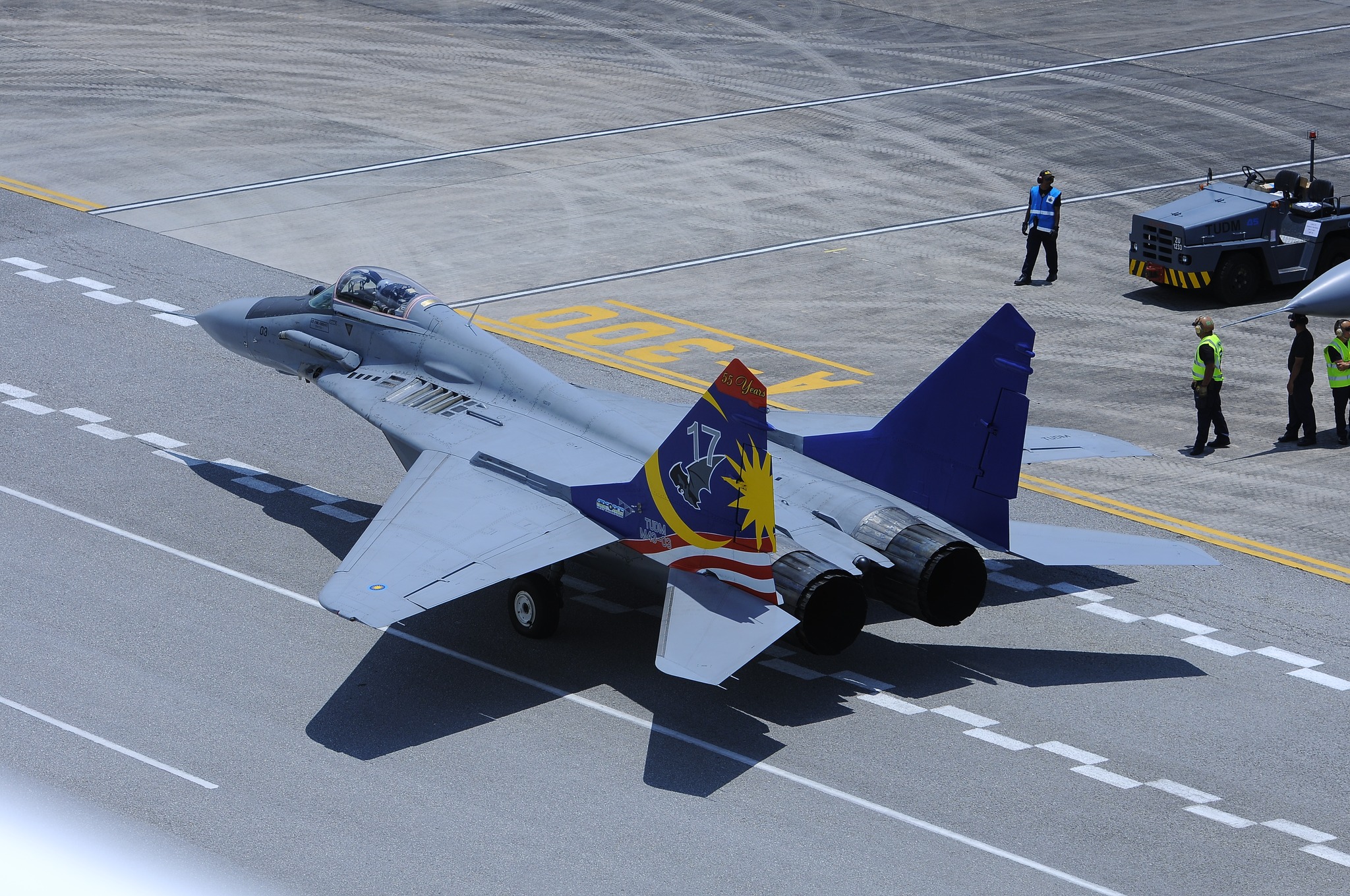
MiG-29N (M43-03) with special tail art to commemorate the Royal Malaysian Air Force's 55th anniversary.
The M43-03, which belonged to the 17th Squadron, was also the lead aircraft of the "Smokey Bandits" aerobatic display team.
Photo by the Royal Malaysian Air Force
The MiG-29, NATO callsign Fulcrum, was a Soviet air superiority fighter/interceptor developed by the Mikoyan design bureau to fulfill the Soviet requirement for a light-weight fighter. The design, initially referred to as Product 9 and later designated MiG-29, first took to the air on 6th October 1977 before finally making its international debut at a Finnish air show in 1986. It was lethal in close-range and praised for its superb maneuverability, but early MiG-29s were hampered by their short-range, which was compounded by their lack of air-to-air refueling capability, and the avionics present on early models as well as those exported to Soviet-friendly countries were generally subpar.
Background
Initial interest in the MiG-29 from the Malaysian side was expressed in 1992. It was one of a number of aircraft on the Malaysian government's shortlist, including the F-16, F-18, Mirage 2000, and Rafale.
Two years of negotiations ensued before a ~$500 million deal for 16 air superiority variants (designated MiG-29N) and two double-seater trainers (MiG-29NUB) were signed in 1994. The deal also included the construction of a local service centre. Of the ~$500 million, the Malaysian government paid 20-25% of that figure in palm oil.
The Malaysian Variant
While some reports (which I can no longer find) claim that the aircraft delivered were new builds fresh off the production line, it's much more likely they came from an existing stockpile, the result of Russian defence spending cuts.
It was speculated and reported as such by Russian media at the time that Malaysia was set to receive the export variant of the 9.13S, which was the most advanced version of the MiG-29 available at the time. The "S" models included upgraded radar, optical tracking and navigation, weapon, and flight control systems, as well as strengthened hardpoints and reinforced airframes.
What ended up being delivered to the Malaysians' however were MiG-29s of an older revision, 9.12, which lacked the dorsal hump present on 9.13 MiG-29s that served as a housing for a Gardeniya-1 jammer as well as extra fuel. It was however possible to apply the "S" upgrades to existing 9.12 MiG-29s, which were designated 9.12S, while the 'detuned' export version was known as the 9.12SD.
Malaysian MiG-29s were modified to match the 9.12SD specification but also differed in incorporating Western-sourced avionics, such as navigation and identification friend-or-foe systems, as well as the addition of in-flight aerial refueling probes between 1998 and 1999. These modified single-seater 9.12SD aircraft were designated MiG-29N, while their two-seater counterpart meant for training were designated MiG-29NUB in Malaysian service.
One significant aspect of Malaysia upgrading their MiG-29s to the 9.12SD standard was that they now had the ability to fire Russian R-77E (AA-12 Adder) medium-range missiles. Though the Malaysian government never publicly disclosed whether they had any in stockpile at the time, US intelligence were sure enough that the Clinton administration approved the sale of the R-77's counterpart, the AIM-120 AMRAAM, to Thailand and Singapore.

Retractable aerial refueling probe on a MiG-29.
Photo by Russian pilot Artur Sarkisyan.

Graphic showing the possible loadouts of the MiG-29SE or 9.13SE.
In Service
Malaysian MiG-29N and NUBs were separated into two squadrons, 17th and 19th, both based out of Kuantan Air Base on the peninsular east coast, with eight MiG-29Ns and one NUB each.
In September 1998, a MiG-29N crashed after suffering from a hydraulic failure and battery failure. While the pilot ejected and survived, subsequent checks on all Malaysian MiG-29 aircraft showed that none of the batteries met manufacturer standards.
The second and last crash happened in 2004 after a MiG-29N's engine caught fire after takeoff. Like the first crash, the pilot ejected and survived.
In 2006, it was reported that the air force would be deactivating its MiG-29Ns due to a lack of pilots to make way for soon-to-arrive Su-30MKMs. Three reasons were given for the shortage; the lack of lead-in trainer aircraft, shortcomings in the air force's pilot training programme, and an increasing number of pilots leaving for civil aviation. Judging off online forum posts of the time, this came as a bit of a shock. Unfortunately I haven't been able to find any follow-up reports about this and as such I'm not able to verify if any MiG-29s were actually deactivated. Some MiG-29 pilots were moved onto the newer Su-30s, however, such as current (as of November 2024) air force chief Mohd Asghar Khan callsign "Gunjiz".
It was also reported that all MiG-29s had, by 2006, been grouped under 19th Squadron instead of being split into two. However, pictures of all MiG-29s taken after 2006 have the emblem of 17th Squadron, a bat, rather than the cobra of the 19th Squadron, and some news reports refer to "the" MiG-29 squadron as 17/19th, rather than just 17th or 19th.
In 2009, the Malaysian minister of defence announced it would be phasing the MiG-29s out of service by the end of 2010 owing to their increasing maintenance costs. This would reportedly save the government a sum of $76 million or MYR260 million per annum.
The air force's remaining fleet of 14 MiG-29Ns and two MiG-29NUBs were reportedly put up for sale with a price tag of MYR300 million, which amounted to something close to $82 million at the time. Russia showed some interest in trading them for six new Su-30MKMs to complement the air force's already existing fleet of 18 aircraft of that type, but nothing came of this proposal.
With some lobbying, the minister of defence was persuaded to retain a reduced number of MiG-29s in service until 2015. The air force had argued that the MiGs could remain in service for another two years at least, and as long as eight years if a life-extension program was undertaken. Six MiG-29s ultimately fell victim to this cost cutting measure, leaving the air force with just eight operational MiG-29Ns and two NUB trainers.
Proposed Upgrades
There were multiple offers to upgrade the Malaysian MiG-29N fleet over the years. Perhaps the most comprehensive was in 2015, the year the MiG-29s were supposed to be retired from service. Coming from the Aerospace Technology Systems Corporation (ATSC), a local company founded in partnership with MiG, the upgrades offered were similar to those done for the Russian (MiG-29M/SMT) and Indian (MiG-29UPG) air forces.
The MiG-29Ns would've been given a new Zhuk-ME FGM-229 radar system and modified to accept air-to-ground munitions, with the new radar giving the MiG-29Ns improved air-to-air capability, allowing it to track ten targets and engage four simultaneously. The MiG-29Ns would've also been fitted with new glass cockpits with hands on throttle-and-stick controls, a significant upgrade over the existing cockpit design, which was outdated even in the 1990s.

Former West German pilot Peter "Stoini" Steiniger recounted in the Smithsonian's "Air & Space" magazine
that the MiG-29 cockpit was "terribly labor-intensive". Photo taken from Wikimedia, uploaded by IrasD.
Though not mentioned in any reports, it's safe to assume that they would've also been fitted with new targeting and electronic countermeasure systems similar to those found on the Indian MiG-29UPGs.
The upgraded MiG-29Ns' operational range would've also been increased by as much as 30% through two new fuel tanks; one ventral and the other dorsal (the 9.13 "hump"). Curiously, Indian reports state the UPGs had their operational range extended by 40% with the same fuel tank additions.
The airframe was to be strengthened as well so as to increase its lifespan from 4,000 hours to 6,000 hours. The most heavily used airframe at that point had only accumulated 1,800 hours of use, or an average of 90 hours per year since the type entered service in 1995. For comparison, NATO pilots are supposed to do a minimum of 180 hours of flying per year.
The ATSC claimed that the upgraded MiG-29Ns would've remained supportable for at least another 20 years while only costing a fraction of what the government planned to spend on replacement jets (that as of November 2024, have yet to be purchased), but the proposal was never taken up by the Malaysian government for one reason or another.
MiG offered a cheaper upgrade package in 2017 that would've modified the MiG-29Ns to accept guided air-to-ground munitions while retaining the base N019ME radar. This upgrade solution was referred to by MiG as the MiG-29SM (mod.) and implemented on Burmese MiG-29s, but like in 2015, not taken up by the Malaysian government.
Retirement
The MiGs were kept in service past their intended retirement date of 2015, but serviceability issues meant only six of the ten still in service were actually air worthy. The type was finally grounded in 2017 pending a final decision on their future.
In late 2019, the Russian government offered to buy back Malaysia's MiG-29 fleet and replace them with a number of MiG-35 aircraft, itself a development of the MiG-29. Some interest was expressed by the Malaysian government, then headed by a political Russophile, the same man who led the country in the 1990s when the MiG-29Ns were first bought. However, he resigned not too long afterward in 2020, and no deal was ever reached between the subsequent Malaysian governments and their Russian counterpart.
Malaysian MiG-29s remain in storage to this day, but two have already been earmarked to be turned into gate guardians as of November 2024. It's unclear what will happen to the rest of the airframes.
References
Richardson, Michael, "Cut-Rate MiG Offer To Malaysia Worries West's Arms Makers", The New York Times, 18 April 1992
Goldberg, Carey, "Jet Deal Boosts Moscow’s Arms Exports : Military: Sale of 18 MiGs to Malaysia is biggest in years. It shows Russia has learned to compete in world market.", Los Angeles Times, 7 June 1994
Richardson, Michael, "Defense Chief Hints He Could Turn to U.S. for Jets : Malaysia Hesitates on MiGs", The New York Times, 13 July 1993
Richardson, Michael, "U.S. F-18 Gains on MiG for Malay Deal", The New York Times, 26 March 1993
"Malaysia to purchase MiG-29s", United Press International, 2 June 1994
Lake, Jon, "Jane's How to Fly and Fight in the Mikoyan Mig-29 Fulcrum: At the Controls", 1 January 1998
Horák, Martin, "MiG-29SD a MiG-29N/NUB", Ruslet
"The Mikoyan MiG-29 (9-13) and MiG-29S (9-13S) 'Fulcrum-C', sirviper.com
Andrzej Jeziorski, "Malaysian defenders", Flight International, 1 December 1999
"Malaysian MiG order details", Flight International, 15 February 1995
Alexander Vilovich, "Too Many Cooks?", Flight International, 16 August 1995
Gill, Bates, with Mak, J. N., "Arms, Transparency and Security in South-East Asia", Stockholm International Peace Research Institute, 1997
Richardson, Michael, "Thai demand for a Potent Missile Puts U.S. in a Bind", The New York Times, 13 December 1995
Dzhirhan, Mahadzir, "Malaysia to place MiG-29s in storage", Jane's Defence Weekly, 28 July 2006
"Race On to Offer Replacement As RMAF Phases Out MiG-29N", defence-aerospace.com, 4 December 2009
"Malaysia to Phase Out MiG-29N Jets", Airforce Technology, 28 October 2009
"Government Saves RM260 Million By Phasing Out MiG-29N", defence-aerospace.com, 28 October 2009
Abas, Marhalim, "MiG-29N and the Middlemen Mafia", Malaysian Defence, 16 September 2009
Abas, Marhalim, "Who will buy our Migs?", Malaysian Defence, 24 December 2009
Francis, Leithen, "Malaysia aims to upgrade air force with new fighters, AEW aircraft", 13 April 2010
"Local Company Offers To Upgrade RMAF MIG-29N Aircraft", Bernama, 20 March 2015
Pittaway, Nigel, "Malaysian Company Proposes MiG-29 Upgrade", Defense News, 29 March 2015
Darling, Dan, "With MRCA Project Stalled, Royal Malaysian Air Force Plans MiG-29 Upgrade", Defence and Security Monitor, 15 June 2015
Karnozov, Vladimir, "Myanmar MiG-29 Upgrade Revealed: Will Malaysia Follow?", ainonline.com, 28 March 2017
"Russia, Malaysia Sign Agreement on Modernization of Malaysian MiG-29", Sputnik, 19 July 2017
Pocock, Chris, "Malaysia Grounds MiG-29s and Rethinks Future Fighter", ainonline.com, 9 November 2017
Abas, Marhalim, "Selamat Jalan Fulcrum, Finally?", Malaysian Defence, 11 November 2018
"Malaysia considering Russian offers on new MiGs, says Dr M", Free Malaysia Today, 5 September 2019


No comments:
Post a Comment